Braindump: QUANTUMINSERT staring us right in our face? Intel Management Engine as the ultimate backdoor

•January 19, 2014 • Leave a Comment

Note: The “brain dump” series is akin to what the support.microsoft.com team calls “Fast Publish” articles—namely, things that are published quickly, without the usual level of polish, triple-checking, etc. I expect that these posts will contain errors, but I also expect them to be mostly correct. I’m writing these up this way now because they’ve been in my “Important things to write about” queue for ~5 years. Alas, these topics are so broad and intricate that a proper treatment would take far more time than I have available at the moment.

EricLaw [ex-MSFT]

This post is a “brain dump” as described by the Microsoft support team. I’m attempting to publish many an article held back by perfectionism, and to publish time-sensitive ideas; special thanks to my first semester freshman year writing teacher,  anybody

THIS PAGE WILL BE COMPLETED IN THE NEXT FEW DAYS! WORK IN PROGRESS! UPDATE:NEARING COMPLETION

I’ve been thinking about the NSA’s office of Tailored Office Operations, and how  some of their exploits may work.

I’ve known for years that Intel’s Management Engine is a persistent bastard. It hitches on to many intel drivers and associated control applets. It can be remotely installed. Online “Store-bought” (preconfigured) computers offer the Management Engine as a feature for computers sold without an operating system. I didn’t understand that last bit (without an OS), but I figured that it was some ugly BIOS + OS magic that I didn’t  yet understand.  I only grasped the significance of the Management Engine a few days ago.

Over Winter Break, I’ve been busy catching up on reading. Particularly on Computer organization, Processor microarchitecture,  Translation Lookaside Buffers, page tables, processor datapaths & codepaths, kernel design, protection rings, the interaction of the kernel & the processor, and other really low-level things.

Yesterday I caught up on another concept, that of negative protection rings,  a concept mysterious and captivating as negative resistance, negative refraction indicesnegative gravitation (mirror 1), negative impedance, negative bulk moduli, and negative absolute temperature; a concept so exotic that I had neither conceived, nor would I ever so much as consider-but for derivation by formal reasoning.  Truly compelling, but I digress.

The idea of negative protection rings has, in fact, long been considered academically – considered that is. The incredible resources required to actually properly exploit (i.e. fully functioning rootkit) these lower rings ensures that said exploits are never within reach of the academic community.

-1

The first negative protection ring is, in simplest of terms, a mechanism explicitly designed to operate outside of the operating system’s reach,  but not explicitly designed to do so maliciously. Ring -1 is hardware acceleration intended to allow OS virtualization at tolerable speeds, and in this role it is known as a Hypervisor. As a Hypervisor it’s job is to present a convincing image of actual hardware to the virtualized ‘guest’ OS, allowing the Hypervisor (the ‘host’) to share a single physical computer among multiple guest OSs. If each OS were to (try to) share control of the same hardware without a Hypervisor, they’d all crash and burn.

Continue reading ‘Braindump: QUANTUMINSERT staring us right in our face? Intel Management Engine as the ultimate backdoor’

Harvesting the world’s (wasted) mechanical energy

•December 10, 2013 • Leave a Comment

With one stomp of his foot, Zhong Lin Wang illuminates a thousand LED bulbs – with no batteries or power cord. The current comes from essentially the same source as that tiny spark that jumps from a fingertip to a doorknob when you walk across carpet on a cold, dry day. 

-Georgia Tech News Center (John Toon)

Dr.Zhong Lin, the Chair in Materials Science and Engineering & director of the Center for Nanostructure Characterization,  has leveraged the enormous surface area enabled by nanostructures & the triboelectric effect to generate incredible quantities of electricity.

Since their first publication on the research, Wang and his research team have increased the power output density of their triboelectric generator by a factor of 100,000 – reporting that a square meter of single-layer material can now produce as much as 300 watts

-Georgia Tech News Center (John Toon)

Continue reading ‘Harvesting the world’s (wasted) mechanical energy’

“The Invisible Bicycle Helmet | Fredrik Gertten”

•November 11, 2013 • 2 Comments

This is brilliant. Simply brilliant.

Cyber-weapon authors catch up on blog reading

•October 27, 2013 • Leave a Comment

The arms race continues.

Nate Lawson's avatarrdist

One of the more popular posts on this blog was the one pointing out how Stuxnet was unsophisticated. Its use of traditional malware methods and lack of protection for the payload indicated that the authors were either “Team B” or in a big hurry. The post was intended to counteract the breathless praise in the press for the advent of sophisticated “cyber-weapons”.

This year, more information was released in the New York Times that gave more support for both theories. The authors may not have had a lot of time due to political pressure and concern about Iran’s progress. The uneasy partnership between the US and Israel may have led to both parties keeping their best tricks in their back pockets.

A lot of people seemed skeptical about the software protection method I described called “secure triggers”. (I had written about this before also, calling it “hash-and-decrypt”.) The general…

View original post 596 more words

An Elegant & Reliable Door Sensor

•October 20, 2013 • 8 Comments

Schematic for door sensor.

In this configuration, with the second iteration of my sensing algorithm, draws ~10ma idle – near the absolute minimum for an Arduino Leonardo. Diagram created with Fritzing.

Last Thursday, October 3rd of 2013 (when I started writing this, as I am so very productive), I was thinking about door sensing – how could I measure the state of the door? I brainstormed with my roommate (Ryan Kubik, mechanical engineering), and we came up with all kinds of ideas; magnetic (à la home security systems), mechanical, ultrasonic, and acceleration, among others.

At one point, I remembered Jack Andraka’s discovery of an electrical-resistance-of-blood test for pancreatic cancer, and started poking around with my multimeter. It’s truly amazing what happens when someone throws a multimeter at a problem.

I turned the multimeter to continuity test mode, and in no time I noticed that the strike plate (the metal thing in the wall, where the bolt docks) is electrically connected to the handle!

Fifteen minutes later, I’d wired an arduino & PowerSwitch Tail up to the door. I modified the sample “Blink” program to read a digital pin (in an ugly loop), turning the (built-in LED on pin 13) on if the door’s voltage is high. I connected the arduino’s ground to the strike plate, and the to-read pin to the handle. I attached 10k pullup resistors to the breadboard’s power rails, so that the closed door connected the pin to ground, and the open door allowed the pullup resistor to pull the pin to the +5v rail (split by the pull up/down resistors to 2.5v). Dangling wires blocked the door. It was ugly and a hack, but functional!

Continue reading ‘An Elegant & Reliable Door Sensor’

The Wondrous Voyage into Ourselves

•September 2, 2013 • Leave a Comment

“…taking this voyage of the next ten years, to do it with the public. This is not going to be a scientific voyage, this is going to be a voyage where everyone can participate; and when we have programs where the project will be existing in every science museum – this initiative is actually being led by the israeli science museum – we have programs that is going to allow the public to participate in the project, in terms of ethics, in terms of the science of it, and we’re very excited because we really believe that the biggest benefit besides us scientifically telling you how the brain works and when it can go wrong – the  biggest benefit is in all of us not becoming strangers to ourselves.”

Finally! “IBM Research’s 2006 Almaden Institute Conference on Cognitive Computing”

•August 25, 2013 • Leave a Comment

I’ve finished uploading all files! Check it out.

The great Assumption Parish sinkhole

•August 24, 2013 • 2 Comments

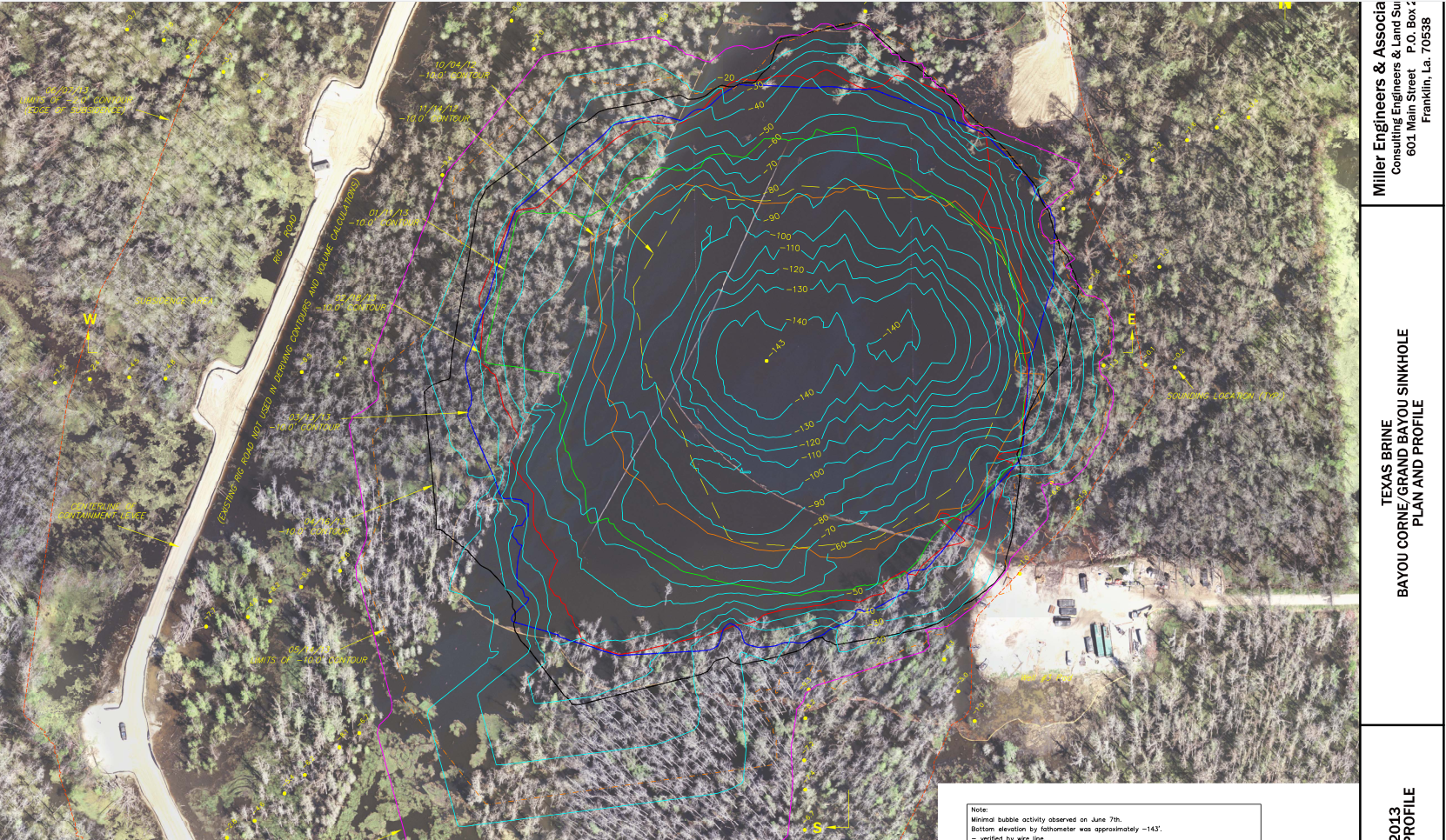
My favorite Facebook page, I Fucking Love Science, Just mentioned this incomprehensible tragedy that’s occurred in Assumption Parish, LA, and linked to a weather channel article about it. But there’s some astounding video that they left out.

The official Assumption Parish YouTube channel shows us a “Slough in” from last Thursday (the 22nd):

By the end of the video the water level (of the WHOLE bayou) has dropped several feet – the previous water level is clearly visible on the trees; and if one video of disappearing trees wasn’t enough for you – they have more:

The parish YouTube channel also has flyover video, which shows the massive size of the area involved, and the growth thereof. First I’ll show you two videos taken on the first:

NOTE the road on the right at 0:02

Then two videos taken on the 13th:

And lastly the 22nd:

But that’s just scratching the surface of the matter.  This is a depth measurement taken a month before those videos.

The probe just keeps going and going and GOING ever deeper – for five full minutes – at which point there’s no more line to measure with! I’m at a loss for words. A post on the Assumption, LA blog  (archived here)notes that reel was 750 FEET long. That’s tremendously deeper than the data from a month earlier(archived here). Simply astounding.

bayou depth


What? My processor is stuck at 1.8ghz?

•August 8, 2013 • Leave a Comment

My laptop just did something really weird to me – I’ve never seen it before. I have an i7-4930mx, and while working in Mathematica it froze at 1.8ghz! Nothing would help! What the hell? Screen Capture below.

Can anybody explain why & what happened?

EDIT: it’s blurry – the raw file

The extraordinary effect of weather on behavior

•August 1, 2013 • Leave a Comment

My doctor once mentioned the extraordinary effect of weather on behavior –  it affects us in many more ways than we are aware of.  He mentioned many things, that sunshine improves mood, that storms (barometric pressure) increases anxiety and promotes anger, and that the arrival of spring induces manic episodes in psychiatric inpatients  – who proceed to run down the street naked. I’ve been convinced, but never actually saw the data behind this finding.

Earlier this evening, as our dorm room reached 75% humidity (with our large dehumidifier running constantly) I remembered this and actually looked it up. I found A multidimensional approach to the relationship between mood and weather in the British Journal of PsychologyPut simply, as in their abstract:

Humidity, temperature and hours of sunshine had the greatest effect on mood. High levels of humidity lowered scores on concentration while increasing reports of sleepiness. Rising temperatures lowered anxiety and scepticism mood scores. Humidity was the most significant predictor in regression and canonical correlation analysis.

The authors note fourteen significant relationships, one of which had a P<0.01 (concentration suffered as humidity rose), and another (sunshine) as the sole predictor of optimism. But they touched on an interesting issue in their discussion, as excerpted:

One area of practical concern in the study of weather is the effect it has on classroom and office performance. Typically, the relationship between performance and temperature has been studied (e.g. Bell, 1981). However, the results of the present investigation suggest that humidity might be a variable that influences important aspects of performance, such as attention (concentration) and alertness (sleepiness). Allen & Fischer’s (1 978) work demonstrated that humidity had a greater impact on performance than temperature. The effect of humidity level on performance appears to be an important area for further research.

Humidity’s effect on concentration should also factor into HVAC design, especially in a dormitory like ours, which approaches 90% humidity without a dehumidifier (bought by us), and where the air conditioners have no (functional) condensate drain.

I remember that one rainy day I’d told a friend about it , but he wasn’t buying it. Right then, we walked by a child laying face flat on the concrete, screaming and banging his fists. My friend needed no further proof. Definitely worth a read.

mirror: A multidimensional approach to the relationship between mood and weather

I should really write a full article on this, à la meta-analysis, but I simply don’t have the time. Instead, here are fascinating related articles:

A Warm Heart and a Clear Head: The Contingent Effects of Weather on Mood and Cognition, mirrored– fantastic n!

Summer in the City: Urban Weather Conditions and Psychiatric Emergency-Room Visits

WEATHER AND CRIME – British Journal of Criminology, WEATHER AND CRIME

Violent Storms and Violent People – mirrored– fascinating article that touches on the similarity between meteorology and psychiatric care, and the role of risk assessment therein.

 
Lucky's Notes

Notes on math, coding, and other stuff

AbandonedNYC

Abandoned places and history in the five boroughs

Open Mind

KIDS' LIVES MATTER so let's stop climate change

I learned it. I share it.

A software engineering blog by György Balássy

Kitware Inc

Delivering Innovation

The Electric Chronicles: Power in Flux

If someone ever tells you that you don't need more power, walk away. You don't need that kind of negativity in your life.

Ted's Energy Tips

Practical tips for making your home more comfortable, efficient and safe

love n grace

feel happy, be happy

Recognition, Evaluation, Control

News and views from Diamond Environmental Ltd.

greg tinkers

Sharing the successes and disasters.

Sam Thursfield

Software and technology from Galicia, Spain

Cranraspberry Blog

Sharing the things I love

Biosingularity

Advances in biological systems.

The Embedded Code

Designing From Scratch

Sean Heelan's Blog

Software Exploitation and Optimisation

EduResearcher

Connecting Research, Policy, and Practice in Education

Popehat

A Group Complaint about Law, Liberty, and Leisure

warnersstellian.wordpress.com/

Home & Kitchen Appliance Blog

Bad Science Debunked

Debunking dangerous junk science found on the Internet. Non-scientist friendly!

4 gravitons

Stories about physics from someone who's been there

Strange Quark In London

A blog about physics, citylive and much procastination

The Lumber Room

"Consign them to dust and damp by way of preserving them"

In the Dark

A blog about the Universe, and all that surrounds it

andrea elizabeth

passionate - vibrant - ambitious

Probably Dance

I can program and like games

a totally unnecessary blog

paolo severini's waste of bandwidth

Musing Mortoray

Programming and Life

PJ Naughter's space

Musings on Native mode development on Windows using C++

  Bartosz Milewski's Programming Cafe

Category Theory, Haskell, Concurrency, C++

Brandon's Thoughts

Thoughts on programming

David Crocker's Verification Blog

Formal verification of C/C++ code for critical systems

10 Minute Astronomy

Stargazing for people who think they don't have time for stargazing.

One Dev Job

notes of an interactive developer

Chief Cloud Architect & DevSecOps SME, Enterprise Architect, Agile Coach, Digital Transformation Leader, Presales & Tech Evangelist, Development Manager, Agilist, Mentor, Speaker and Author

TOGAF Certified Enterprise Architect • AWS Cloud Certified Solutions Architect • Azure Cloud Certified Solutions Architect • Scrum Alliance: Certified Scrum Professional (CSP), Certified Agile Leadership I (CAL 1), CSM, ACSM • Kanban Management Professional (KMP I & KMP II), Certified Enterprise Agility Coach (CEAC) • SAFe: Certified SAFe Architect, SAFe DevOps, Release Train Engineer (RTE), SAFe Consultant (SPC) • Certified Less Practitioner (CLP), Six Sigma (Greenbelt), Training from the Back of the Room (TBR) Trainer • Certified Agile Coach & Facilitator: ICP-ACF & ICP-ACC

The Angry Technician

No, the Internet is not broken.

Kenny Kerr

Creator of C++/WinRT and the Windows crate for Rust • Engineer on the Windows team at Microsoft • Romans 1:16

IT affinity!

The Ultimate Question of Life, the Universe, and Everything is answered somewhere else. This is just about IT.

Eat/Play/Hate

The ramblings of a crazed mind

Molecular Musings

Development blog of the Molecule Engine

The New C++

The latest version of C++ on steroids