
My Facebook account is deactivated, and will be for the next week. http://about.me/ariccio for other ways of contacting me.
Make your own fume-extracting glove box
•July 30, 2013 • Leave a CommentI timed my placeholder post brilliantly 🙂
The weather stripping is a fantastic idea – but it could use a heat resistant/otherwise durable surface for soldering.
A soldering station to rule them all.
•July 28, 2013 • Leave a CommentHere at Poly I often end up discussing the awesome soldering setup that I have at home, but I don’t always have the pictures on hand. I’ve been meaning to do a proper build log + write up on it for nearly a year now, but haven’t had a chance to finish said article.
I can however, post the images that I’ve taken. Images are (sadly) in no order whatsoever, and were taken in the past year. The neater the background, the more recent the photo.


3D printing with liquid metals
•July 14, 2013 • Leave a CommentHoly crap. This video is incredible – it’s been far too long since something got my heart beating THIS quickly! No, really, the possibilities are infinitely more than endless.
Progression 1: Draft 1
•July 10, 2013 • 1 CommentLanguage – be it in the form of a piece of software, a book, a magazine, a newspaper, a song, a speech – has always been the focus of my life, and that thereof humanity’s. Even before I knew language, I babbled in an instinctive attempt at partaking in the infinite exchange of knowledge that language founds. Now that I’ve mastered the tool that is English, now that I understand the meaning of words, the people who use them, the kinds of phrases those people use, and the kinds of ideas those people think about, I can sort through vast mountains of information, and find information otherwise inaccessible. What I’m referring to is Google – but not in the way that most everybody uses it, and thinks of it.
Daniel Russell is a researcher at Google in “Information Retrieval and the Web”, his job is to literally “study the way people search and research“. What he has discovered is that in order to find the right information that flows from the human stream of consciousness into the sea that is the internet, we need to remember that there are people behind those ideas, those words – and that those humans from many different parts of the world use words of their social group to refer to universal ideas. Russell, as described in an article written by John Tedesco, spoke at an investigative reporter’s conference, and stumped the crowd – asking:

“What’s the phone number of the office where this picture was snapped?”
His answer boils down to questions of context – the little details that, together, form meaning. Tedesco says to “Think about how somebody else would write about the topic” – i.e. how they would use slang, the contents of their dictionary, the memes of their time, the kind of place they live in. John McWhorter exemplifies “Edward Gibbon’s “The Decline and Fall of the Roman Empire:””:
“The whole engagement lasted above twelve hours, till the graduate retreat of the Persians was changed into a disorderly flight, of which the shameful example was given by the principal leaders and the Surenas himself.”
That’s beautiful, but let’s face it, nobody talks that way. Or at least, they shouldn’t if they’re interested in reproducing. That — (Laughter) is not the way any human being speaks casually.
The History and the Evolution of Computer Viruses
•June 27, 2013 • Leave a CommentA fascinating look into the history of computer viruses from ~1985-2011.
Some of the early viruses were actually quite funny – see V-sign at ~9:10, or walker at 10:44 and ambulance at 11:25 for far funnier versions, and alex at 11:10 for a neat animation.
Sidenote: the audio is terrible. I can hear a mains hum for half the video. Seriously, FIX YOUR GROUND LOOPS!!!
Qi Wang | Writing the Information into the Brain
•June 26, 2013 • 1 Comment
Columbia Engineering has posted another entry (mirror) in their fascinating series of faculty profiles. Qi Wang is researching methods of directly “writing” information to the brain, thereby enabling direct communication with computers – a field that I have a tremendous interest in, not to mention* my visions therefor. It was a deciding factor in my decision to major in Computer Engineering.
*Well, I’ll give a little glimpse of my visions. As I commented on facebook (mirrored, of course):
Continue reading ‘Qi Wang | Writing the Information into the Brain’
Machines & Humans working together, to each other’s strengths
•June 24, 2013 • Leave a CommentI’m very much into cybersecurity, and I try (however futile) to keep up with the security world – it really is fascinating.
Raphael Mudge presents a fantastic collaborative network attack tool, that enables on-the-fly scripting of automata that can seamlessly work with the humans on the team.
Remember, humans and computers are computational systems – both capable of executing the other’s programs – but have dramatically different strengths. Humans, as slow BUT massively parallel systems, can integrate vast amounts of information, and adapt to novel stimuli easily; can also run a computer program (that’s the job of a programmer), but we are many orders of magnitude slower than the computer at it. Computers, as insanely fast BUT almost entirely serial systems, can run the program that is the human brain, but struggle to run the program of even an individual neocortical column in realtime.
Mirror of The Algorithmic Origins of Life (Goddamn I love that paper!)
RMA
•June 23, 2013 • Leave a Comment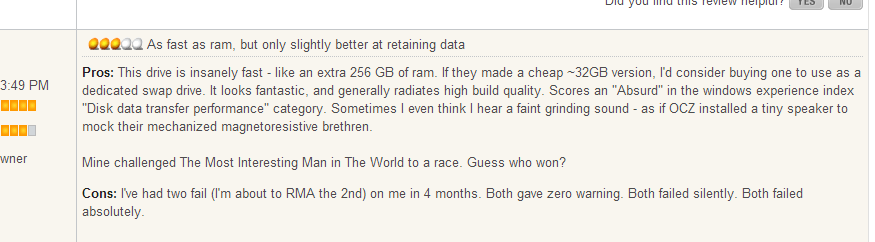
A few weeks ago, ANOTHER SSD silently died. I just submitted my RMA ticket. I thought I’d repost my review of the OCZ Vector.
Pros: This drive is insanely fast – like an extra 256 GB of ram. If they made a cheap ~32GB version, I’d consider buying one to use as a dedicated swap drive. It looks fantastic, and generally radiates high build quality. Scores an “Absurd” in the windows experience index “Disk data transfer performance” category. Sometimes I even think I hear a faint grinding sound – as if OCZ installed a tiny speaker to mock their mechanized magnetoresistive brethren.


